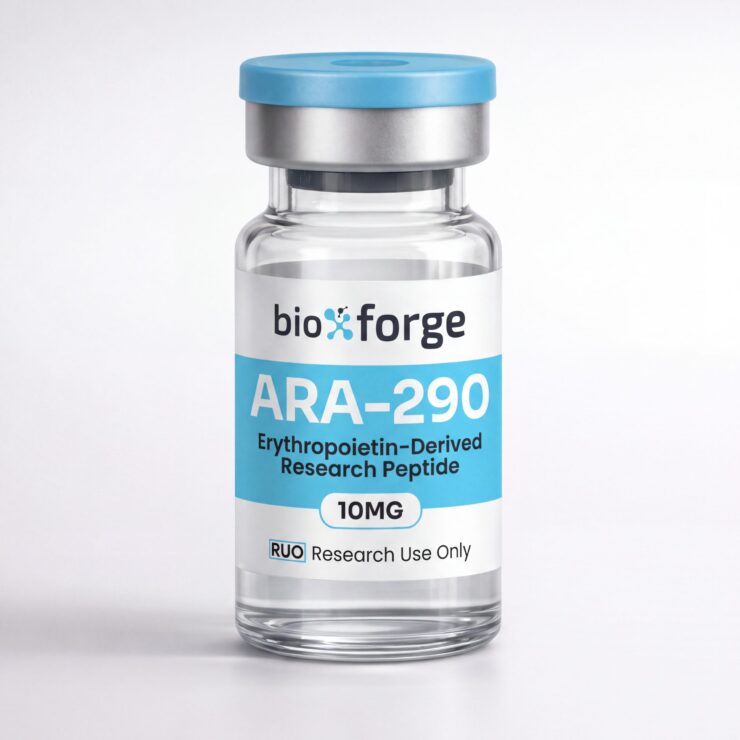



ARA-290 is a synthetic peptide derived from the three-dimensional structure of erythropoietin (EPO), specifically modeled from the helix-B surface region responsible for non-erythropoietic tissue signaling. Structurally, it is a small peptide engineered to retain selective receptor-modulating characteristics while lacking the hematopoietic activity associated with full-length erythropoietin. In laboratory research settings, ARA-290 is classified as an erythropoietin-derived peptide analog and is commonly utilized to investigate cellular stress-response and tissue-signaling pathways.
Mechanistically, ARA-290 has been studied for its interaction with the innate repair receptor (IRR), a receptor complex believed to involve the erythropoietin receptor (EPOR) in association with the β-common receptor (CD131). Activation of this signaling system in experimental models has been associated with modulation of inflammatory pathways, cellular stress signaling, and tissue-response mechanisms. Unlike erythropoietin itself, ARA-290 is designed to selectively engage tissue-protective signaling without significantly stimulating erythropoiesis, making it useful for dissecting non-hematopoietic EPO pathway activity.
In vitro and preclinical research applications commonly include evaluation of cytokine expression, cellular stress markers, mitochondrial signaling, and inflammatory pathway modulation. Investigators may employ ARA-290 in neuronal, endothelial, or epithelial cell systems to study receptor-mediated signaling cascades and downstream transcriptional responses. Its relatively small peptide size and targeted mechanistic profile support controlled experimentation involving peptide–receptor interaction dynamics and tissue-response signaling.
Overall, ARA-290 is regarded as a research-grade peptide analog used to explore innate repair signaling and erythropoietin-derived cellular communication pathways under controlled laboratory conditions. Its selective receptor activity and defined structural origin make it a valuable compound for experimental investigations into peptide-mediated regulatory mechanisms. It is intended strictly for research use in regulated laboratory environments.